> For the complete documentation index, see [llms.txt](https://help.impact.com/llms.txt). Markdown versions of documentation pages are available by appending `.md` to page URLs; this page is available as [Markdown](https://help.impact.com/partner/pt-br/sobre-o-que-voce-gostaria-de-aprender/platform-features/tracking/tracking-links/create-and-manage-links/chrome-extension/apply-to-a-brand-program-via-the-chrome-extension.md). Agents can also search and read this documentation through its [MCP server](https://help.impact.com/~gitbook/mcp).
# Candidate-se a um programa de marca pela extensão do Chrome
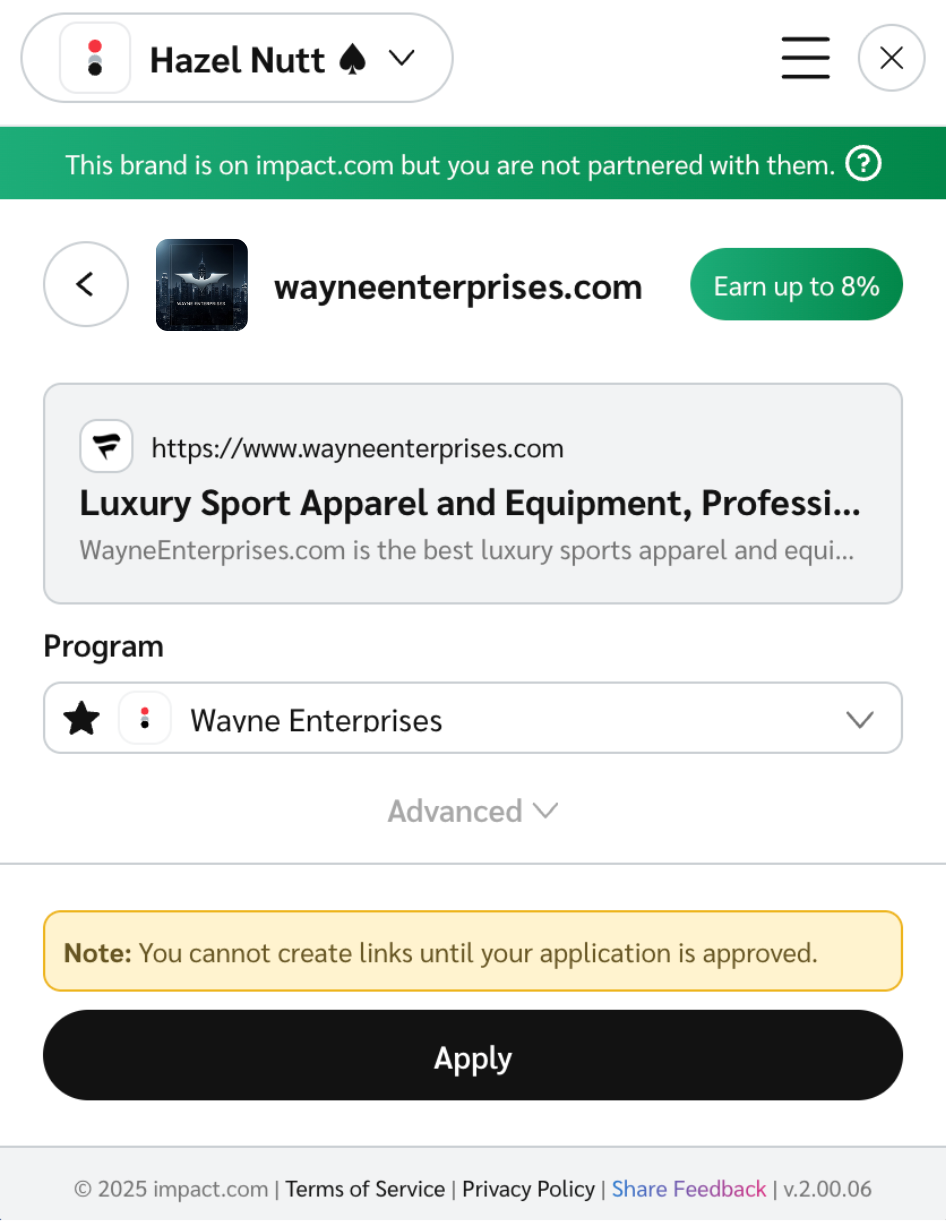
Se você acessar o site de uma marca com a qual não tem parceria, a [extensão do Chrome do impact.com](https://chromewebstore.google.com/detail/impactcom-for-chrome/jliaphkmaknmllgfgfifmaciiindcpmi) notificará você. Essas notificações incluem o seguinte:
* **A marca está no impact.com, mas você não tem parceria com ela:** A marca está no impact.com, mas você não tem um contrato ativo com ela.
* **Você está pré-qualificado para trabalhar com esta marca:** A marca está no impact.com e sua aprovação no programa será automática.
* **Você não está qualificado para se candidatar a este programa:** Seu perfil não atende aos critérios atuais da marca. Você poderá se qualificar mais adiante, então não deixe de visitar o site da marca novamente.
1. No site de uma marca com a qual você não tem parceria, abra a extensão.
2. Selecione **Candidatar-se**.
* Essa ação enviará automaticamente uma solicitação à marca.
* Se houver várias contas de parceiro vinculadas ao seu nome de usuário, use o  **\[Menu suspenso]** menu no canto superior esquerdo para alternar entre as contas e se candidatar usando cada uma delas.
---
# Agent Instructions
This documentation is published with GitBook. GitBook is the documentation platform designed so that both humans and AI agents can read, navigate, and reason over technical content effectively. Learn more at gitbook.com.
## Querying This Documentation
If you need additional information that is not directly available in this page, you can query the documentation by asking a question.
Perform an HTTP GET request on the following URL with the `ask` and `goal` query parameters:
```
GET https://help.impact.com/partner/pt-br/sobre-o-que-voce-gostaria-de-aprender/platform-features/tracking/tracking-links/create-and-manage-links/chrome-extension/apply-to-a-brand-program-via-the-chrome-extension.md?ask=&goal=
```
`ask` is the immediate question: it should be specific, self-contained, and written in natural language.
`goal` is what the user is ultimately trying to achieve, the reason they need the answer. Sharing it helps GitBook give you a better, more relevant answer. A goal is most helpful when it describes the outcome the user wants rather than restating the question. For example, with `ask=how do I create an API token`, a goal like `automate deployments from our CI pipeline` lets GitBook tailor the answer to that use case.
The response will contain a direct answer to the question and relevant excerpts and sources from the documentation.
Use this mechanism when the answer is not explicitly present in the current page, you need clarification or additional context, or you want to retrieve related documentation sections.