> For the complete documentation index, see [llms.txt](https://help.impact.com/llms.txt). Markdown versions of documentation pages are available by appending `.md` to page URLs; this page is available as [Markdown](https://help.impact.com/brand/zh/what-would-you-like-to-learn-about/platform-features/tracking/credit-policies/last-click-credit-policy-explained.md).
# 末次点击归因政策说明
Last Click 是 impact.com 上所有品牌的默认归因政策。这是推荐使用的政策,也被视为行业标准。
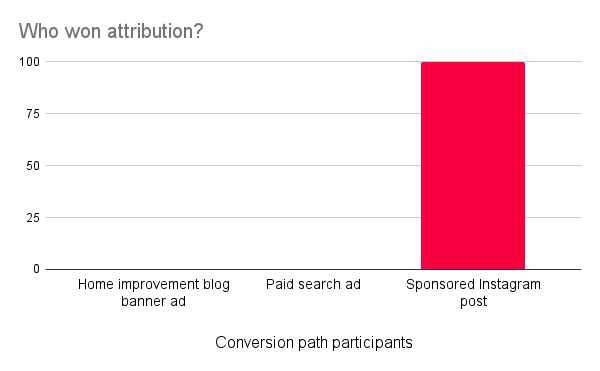
在 Last Click 归因政策下,在转化路径中促成最后一次点击的合作伙伴将获得 100% 的归因,通常也会获得该次转化的全部佣金。不过,获得全部归因可能取决于你的 [参与奖励](/brand/zh/what-would-you-like-to-learn-about/platform-features/contracts-and-template-terms/template-terms/payout-adjustments/participation-bonuses-explained.md) 设置。
{% hint style="info" %}
**兼容性说明:** 不同于 [最后加购](/brand/zh/what-would-you-like-to-learn-about/platform-features/tracking/credit-policies/last-to-cart-credit-policy-explained.md),Last Click 不需要手动 [通用跟踪标签(UTT)](/brand/zh/what-would-you-like-to-learn-about/platform-features/tracking/javascript-tag-tracking/tracking-with-universal-tracking-tag-utt.md) `trackCart` 实施。如果你使用应用或插件集成,包括 Shopify、WooCommerce 或 BigCommerce,请使用不需要 `trackCart`,例如 Last Click。
{% endhint %}
示例场景
让我们以 Acme Corporation 为例。该公司最近开设了一家线上直面消费者(DTC)涂料商店。当 Acme 使用 impact.com 的 Starter Edition 完成入驻时,他们提到自己刚接触联盟营销和合作伙伴关系,希望在升级其项目之前先进一步了解漏斗。
在这种情况下,由于 Acme 刚接触营销漏斗,运行的是 Starter Edition 项目,而且并不寻求高度定制的解决方案,因此他们会在所有事件类型中使用 Last Click 作为政策。
采用这种归因逻辑,Acme 可以让无限数量的合作伙伴参与客户的转化路径,但只有在客户购买前推动最终点击的那个合作伙伴,才能获得该次转化的归因和佣金。
自项目启动以来,Acme 的第一位客户通过点击家居装修博客上的横幅广告找到了他们的网站,并将几件商品加入购物车。该客户当时没有下单,但之后又通过点击赞助搜索结果回到网站并添加了一些额外产品。不过,他们直到点击一则赞助的 Instagram 帖子后才完成购买。
在这里,Instagram 帖子所属的合作伙伴将获得推动转化的全部归因和佣金,尽管他们并没有促使客户将任何商品加入购物车。
---
# Agent Instructions
This documentation is published with GitBook. GitBook is the documentation platform designed so that both humans and AI agents can read, navigate, and reason over technical content effectively. Learn more at gitbook.com.
## Querying This Documentation
If you need additional information that is not directly available in this page, you can query the documentation by asking a question.
Perform an HTTP GET request on the following URL with the `ask` and `goal` query parameters:
```
GET https://help.impact.com/brand/zh/what-would-you-like-to-learn-about/platform-features/tracking/credit-policies/last-click-credit-policy-explained.md?ask=&goal=
```
`ask` is the immediate question: it should be specific, self-contained, and written in natural language.
`goal` is what the user is ultimately trying to achieve, the reason they need the answer. Sharing it helps GitBook give you a better, more relevant answer. A goal is most helpful when it describes the outcome the user wants rather than restating the question. For example, with `ask=how do I create an API token`, a goal like `automate deployments from our CI pipeline` lets GitBook tailor the answer to that use case.
The response will contain a direct answer to the question and relevant excerpts and sources from the documentation.
Use this mechanism when the answer is not explicitly present in the current page, you need clarification or additional context, or you want to retrieve related documentation sections.