> For the complete documentation index, see [llms.txt](https://help.impact.com/llms.txt). Markdown versions of documentation pages are available by appending `.md` to page URLs; this page is available as [Markdown](https://help.impact.com/brand/zh/what-would-you-like-to-learn-about/platform-features/protect-and-monitor-your-performance-program/social-monitoring/review-social-monitoring-results.md).
# 查看社交监控结果
社交监测可让你查看合作伙伴在社交媒体上何处推广你的业务,以及这些帖子是否存在任何风险。然后,你可以决定是否记录违规,以便合作伙伴更正这些帖子。
#### 查看社交监测结果
1. 在左侧导航栏中,选择  **\[保护]** → **监控** → **社交**.
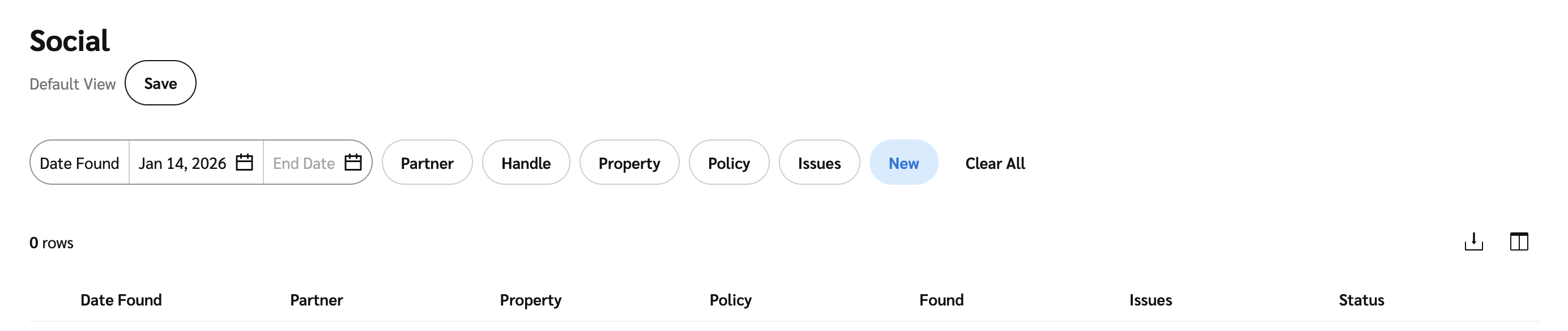
2. 使用筛选器查找特定的社交审核。
筛选项参考
| 筛选器 | 说明 |
| --------- | ------------------------------------------------------------------------------------------ |
| 发现日期/结束日期 | 你想查看的已审核帖子日期范围。 |
| 合作伙伴 | 按合作伙伴筛选社交审核。 |
| 账号名 | 按合作伙伴的账号筛选。 |
| 属性 | 按合作伙伴的社交账号筛选。 |
| 政策 | 按特定的社交政策设置筛选社交审核。
可以设置多个政策来监测不同的合规原因。例如,FTC 合规或品牌安全。
|
| 问题 | 按特定账号上发现的问题类型筛选。
问题包括未经批准的术语、品牌安全,或者在需要披露时未发现披露。
|
| 状态 | 按审核记录的状态筛选。
默认状态设置为 新建 ,但也可以查看其他状态,例如 归档 或 账号已忽略 。
|
表参考
| 列名 | 说明 |
| ---- | --------------------------------------------------- |
| 发现日期 | 发现社交审核的日期。 |
| 属性 | 合作伙伴的社交账号。 |
| 合作伙伴 | 合作伙伴的名称和社交账号。
你可以选择合作伙伴名称以查看更多信息或建议条款。
|
| 政策 | 与审核相关的政策。 |
| 已发现 | 社交审核发现日期的帖子和提及数量。 |
| 问题 | 审核中发现的问题数量。 |
| 状态 | 显示社交审核的状态。 |
#### 查看合作伙伴帖子
1. 在……上 *社交* 主界面,将鼠标悬停在你想查看的帖子上,然后选择 **查看**.
2. 如果合作伙伴的帖子不止一个,请使用筛选器查找特定帖子。
帖子筛选器
| 筛选器 | 说明 |
| --------- | ---------------- |
| 搜索栏 | 搜索帖子中的特定文本。 |
| 发现日期/结束日期 | 帖子的日期范围。 |
| 提及 | 筛选包含所选特定提及的所有帖子。 |
| 失效链接 | 筛选包含失效链接的所有帖子。 |
| 赞助 | 筛选所有已赞助或未赞助的帖子。 |
3. 一旦找到帖子,你就可以查看帖子的详细信息:
* 帖子的图片
* 选择图片可在新标签页中查看实际帖子。
* 帖子的内容摘要
* 将鼠标悬停在内容摘要上可查看完整帖子。
* 提及或失效链接的数量
* 你在政策中配置的未经批准术语数量以及这些术语是什么
* 你在政策中配置的品牌安全类别数量以及这些类别是什么
* 赞助
* 帖子是否为赞助内容以及是否有披露。
---
# Agent Instructions
This documentation is published with GitBook. GitBook is the documentation platform designed so that both humans and AI agents can read, navigate, and reason over technical content effectively. Learn more at gitbook.com.
## Querying This Documentation
If you need additional information that is not directly available in this page, you can query the documentation by asking a question.
Perform an HTTP GET request on the following URL with the `ask` and `goal` query parameters:
```
GET https://help.impact.com/brand/zh/what-would-you-like-to-learn-about/platform-features/protect-and-monitor-your-performance-program/social-monitoring/review-social-monitoring-results.md?ask=&goal=
```
`ask` is the immediate question: it should be specific, self-contained, and written in natural language.
`goal` is what the user is ultimately trying to achieve, the reason they need the answer. Sharing it helps GitBook give you a better, more relevant answer. A goal is most helpful when it describes the outcome the user wants rather than restating the question. For example, with `ask=how do I create an API token`, a goal like `automate deployments from our CI pipeline` lets GitBook tailor the answer to that use case.
The response will contain a direct answer to the question and relevant excerpts and sources from the documentation.
Use this mechanism when the answer is not explicitly present in the current page, you need clarification or additional context, or you want to retrieve related documentation sections.