> For the complete documentation index, see [llms.txt](https://help.impact.com/llms.txt). Markdown versions of documentation pages are available by appending `.md` to page URLs; this page is available as [Markdown](https://help.impact.com/brand/zh/what-would-you-like-to-learn-about/account-administration/program-settings/tracking-settings/ensure-gdpr-compliance-using-consent-mode.md).
# 使用 Consent Mode 确保符合 GDPR
同意模式是 impact.com 的一项功能(目前处于测试版),可帮助你在需要用户同意才能进行跟踪的地区最大限度地提升跟踪和归因效果。受影响最主要的地区位于 EMEA——更具体地说,是欧洲经济区(EEA)。
#### 为什么在适用 GDPR 的国家,跟踪更困难?
根据 GDPR,在用户明确提供跟踪同意之前,像 impact.com 这样的公司不得跟踪该用户。通常,这种同意会通过如下所示的弹窗给出。
如果 GDPR 国家/地区的用户没有选择 **全部接受**, [impact.com](http://impact.com) ,就无法放置 cookie 来识别他们,也无法判断该用户最终是否完成转化。一个 [2023 年研究](https://www.advance-metrics.com/en/blog/cookie-behaviour-study/) 发现只有 25% 的用户会选择 **全部接受**,平均而言,而且只有极少一部分用户会选择自定义 cookie。大多数用户要么拒绝所有 cookie,要么完全忽略横幅。
#### 在没有同意的情况下,有什么可以跟踪吗?
可以!如果用户点击一个 *忠诚度* 或 *奖励* 需要跟踪才能发放承诺奖励的优惠,你就有权依法跟踪该用户旅程。用户期待获得其奖励(例如返现),而你必须能够跟踪这些行为以验证奖励是否已被获得。
尽管你有权跟踪这些奖励点击,但目前默认并不会对其进行跟踪。这就是同意模式发挥作用的地方。同意模式可让 impact.com 跟踪未获同意的奖励点击及其产生的任何转化,并将这些转化归因给相应合作伙伴。合作伙伴随后便可向其用户发放承诺的奖励。
#### 为什么要使用同意模式?
通常,当由于缺少同意而未能跟踪某次转化时,用户会向你的合作伙伴投诉,而对方会向你和/或 impact.com 提交行动查询。客服团队需要花费时间和精力,最终才发现最初的点击未被跟踪,是因为用户没有提供同意,这也就是用户始终没有获得付款或奖励的原因。
| 角色 | 无同意模式 | 有同意模式 |
| -------- | --------------------------- | -------------------------------- |
| **品牌方** | 你正在错失有效转化,因此低估了你的项目价值。 | 你会在 impact.com 项目中看到更高的转化量。 |
| **合作伙伴** | 最终无法获得其促成的所有转化的归因,因此错失收入。 | 赚更多钱,并减少工单和投诉。 |
| **用户** | 在点击忠诚度优惠并完成购买后,无法持续收到预期的奖励。 | 在忠诚度/奖励网站上获得更好的体验,因为他们能更稳定地收到奖励。 |
#### 同意模式如何运作?
同意模式为合作伙伴提供了一种简单方式,可将任意链接标记为 *奖励链接* (使其免于常规同意要求)。当合作伙伴添加 `im_rewards=1` 到其跟踪链接中时,impact.com 就会知道要跟踪该用户旅程,而忽略同意状态。
**你或你的合作伙伴如何开始使用同意模式?**
{% tabs %}
{% tab title="品牌" %}
你需要对集成做一项小改动,这意味着你需要借助集成团队来协助完成一次 JavaScript 更新。这个 [同意模式集成指南](https://integrations.impact.com/integration-guides/for-brands/tracking-integrations/integrate-consent-mode-on-impact.com) 会让他们走上正确的方向,而 impact.com 技术支持团队会在需要时提供帮助。
{% endtab %}
{% tab title="合作伙伴" %}
合作伙伴需要将 `im_rewards=1` 参数附加到任何对应忠诚度或奖励优惠的跟踪链接中。该参数仅对 Loyalty/Cashback 合作伙伴可用,它会告诉 impact.com 该链接是奖励链接,因此免于常规同意要求,并且无论同意状态如何都应跟踪该用户旅程。
了解更多关于 [为奖励项目实施跟踪](/partner/zh/ni-xiang-liao-jie-shen-me/platform-features/tracking/tracking-links/link-parameters/implement-tracking-for-rewards-programs.md) 作为合作伙伴。
{% endtab %}
{% endtabs %}
**你能用流程图解释同意模式吗?**
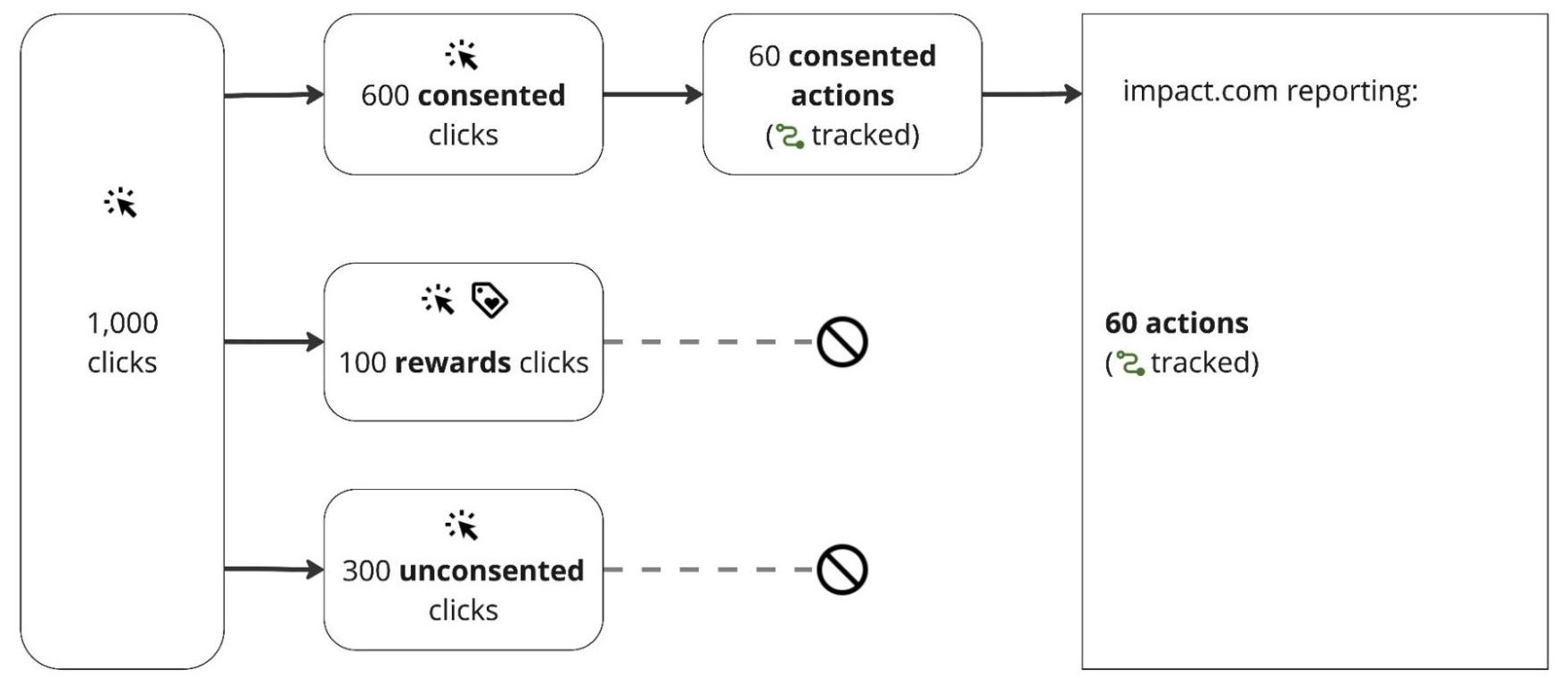
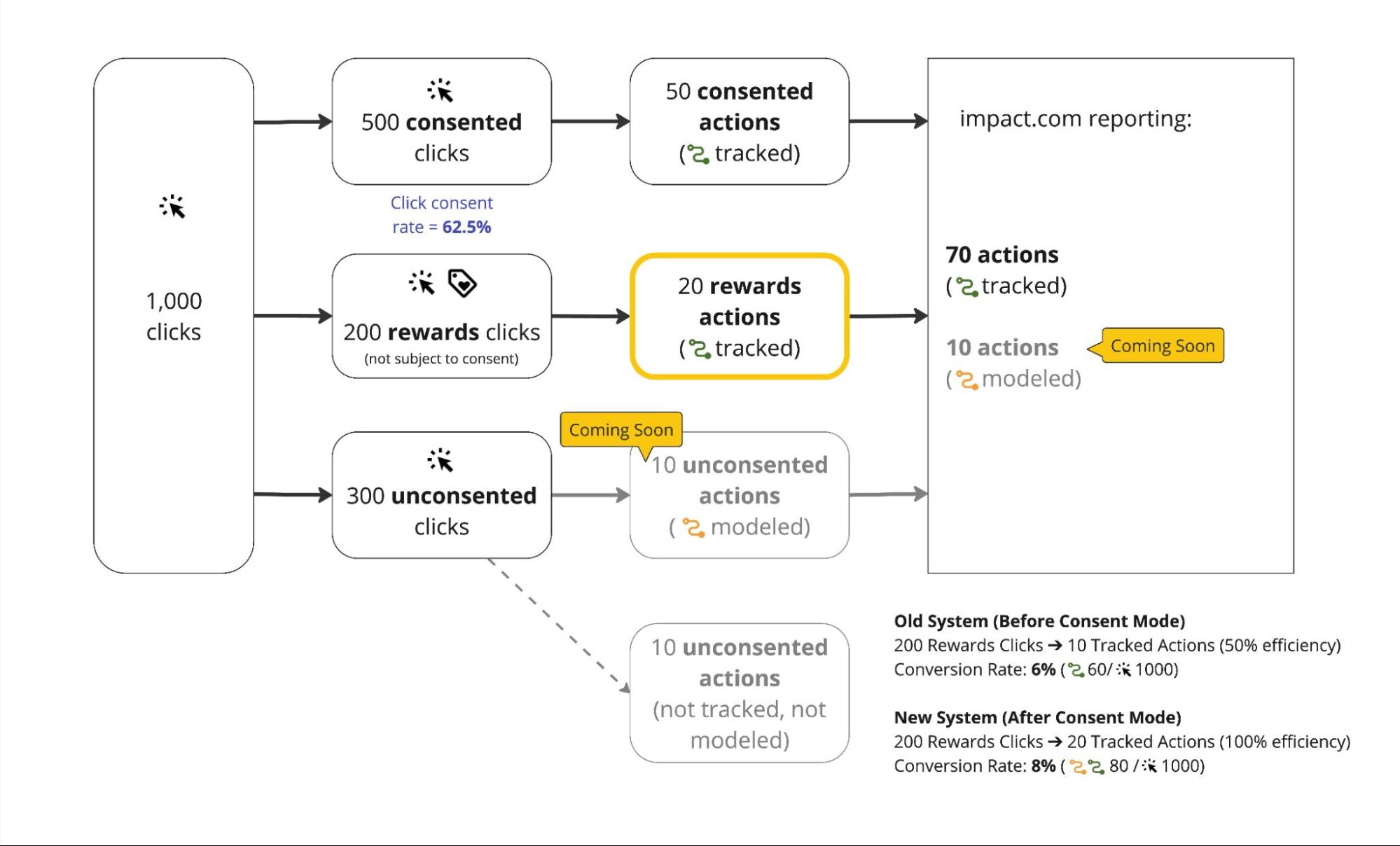
可以!让我们以 1000 次点击为例。在 GDPR 国家/地区且需要同意时,impact.com 只会跟踪和归因用户已提供同意的点击。在这个例子中,40% 的点击无法被归因。实际上,这一比例可能高达 80-90%。
借助同意模式,impact.com 可以将这 1000 次点击分为三组:
| 点击组 | 示例 |
| ------------- | ---------------------------------------------------------------------------------------------------------------------- |
| **已同意点击** | 在 1000 次点击中,有 500 次获得了同意。这些点击产生了 50 个已同意行为,全部都能在 impact.com 的报告中准确跟踪。请参见下方示例图。 |
| **未获同意的奖励点击** | 奖励点击是一个独立类别,因为它们代表用户请求的服务,跟踪它们不需要同意。
来自奖励项目的 200 次点击可转化为 20 个奖励行为,也会通过同意模式被完全跟踪。请参见下方示例图。
|
| **未获同意的点击** | 有意思的地方在这里。对于 300 次未获同意的点击,impact.com 可以建模出额外 10 个行为。同意模式会收集额外信号,使 impact.com 能够准确建模这些行为。即将推出的这一建模能力将带来更高的透明度。请参见下方示例图。 |
得益于同意模式,报告会反映来自已同意点击和奖励点击的 70 个已跟踪行为。随着即将推出的同意建模功能,impact.com 也将开始对未获同意的点击进行行为建模。这将让你看到有多少有效行为因未同意而未被跟踪。
---
# Agent Instructions
This documentation is published with GitBook. GitBook is the documentation platform designed so that both humans and AI agents can read, navigate, and reason over technical content effectively. Learn more at gitbook.com.
## Querying This Documentation
If you need additional information that is not directly available in this page, you can query the documentation by asking a question.
Perform an HTTP GET request on the following URL with the `ask` and `goal` query parameters:
```
GET https://help.impact.com/brand/zh/what-would-you-like-to-learn-about/account-administration/program-settings/tracking-settings/ensure-gdpr-compliance-using-consent-mode.md?ask=&goal=
```
`ask` is the immediate question: it should be specific, self-contained, and written in natural language.
`goal` is what the user is ultimately trying to achieve, the reason they need the answer. Sharing it helps GitBook give you a better, more relevant answer. A goal is most helpful when it describes the outcome the user wants rather than restating the question. For example, with `ask=how do I create an API token`, a goal like `automate deployments from our CI pipeline` lets GitBook tailor the answer to that use case.
The response will contain a direct answer to the question and relevant excerpts and sources from the documentation.
Use this mechanism when the answer is not explicitly present in the current page, you need clarification or additional context, or you want to retrieve related documentation sections.