> For the complete documentation index, see [llms.txt](https://help.impact.com/llms.txt). Markdown versions of documentation pages are available by appending `.md` to page URLs; this page is available as [Markdown](https://help.impact.com/brand/what-would-you-like-to-learn-about/platform-features/review-partner-applications/automate-partner-application-processing/set-up-a-workflows-reject-message.md).
# Set up a Workflows Reject Message
Take the PXA course
You can reject a partner's application to your program with a reject message set up via [workflows](/brand/what-would-you-like-to-learn-about/platform-features/review-partner-applications/automate-partner-application-processing/create-workflows-to-automatically-process-partner-applications.md). This message could help the partner understand why their application was rejected, how to rectify the issue, and possibly re-apply.
#### Set a workflow reject message
1. In the left navigation menu, select  **\[Engage] → Partners → Automation →** [Workflows](https://app.impact.com/secure/advertiser/engage/fr/ps-bar-ui.ihtml).
2. Select **Create Workflow** in the upper-right corner of the screen.
* Alternatively, find an existing workflow you want to update, hover your cursor over it, and select **Edit**.
* Fill in the required fields. See the [workflow form reference](/brand/what-would-you-like-to-learn-about/platform-features/review-partner-applications/automate-partner-application-processing/create-workflows-to-automatically-process-partner-applications.md#create-a-workflow-0-0) for further guidance.
3. In the *Action Type* section, use the  **\[Drop-down menus]** to select **Process Application** and **Reject**.
* A message box will appear where you can type a custom reject message that will be sent to the partner.
* Note the character limit of 255.
4. Once you're done building out your workflow, select **Create** or **Save**.
#### Update program-specific rejection emails
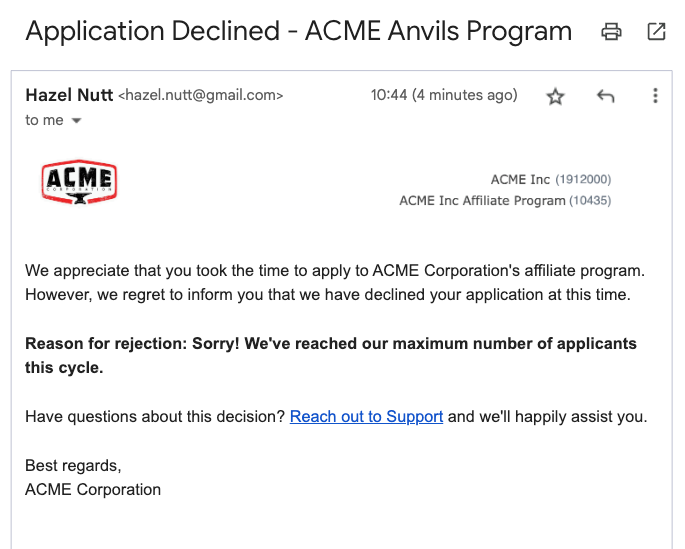
If you make use of custom program-specific rejection emails, you'll need to update the email body to include a `{rejectReason}` token. This will ensure that your custom Workflow reject message is included in the rejection email.
1. From the top navigation bar, select  **\[User profile] → Settings**.
2. On the right-hand side under *Branding*, and select **System Emails and UI Messages**.
3. Navigate to the *Rejection Email* field and select  **\[Edit]**.
4. Select  **\[Radio button]** **Send program specific rejection email**.
5. In the *Subject* field, input a custom subject for the email.
6. In the *HTML Email Body* field, input your customized email message with any relevant HTML code.
* You can add special tags in the text that get dynamically replaced when the email is generated.
* When setting a rejection message, make sure to include the tag **`{rejectReason}`**.
7. Select **Save**.
Example email
{% hint style="info" %}
**Note:** Other system-generated reject reasons could also appear in the rejection email. Examples of these reasons include being rejected by Impact AI, being suspended, or being on a blocklist.
{% endhint %}
---
# Agent Instructions
This documentation is published with GitBook. GitBook is the documentation platform designed so that both humans and AI agents can read, navigate, and reason over technical content effectively. Learn more at gitbook.com.
## Querying This Documentation
If you need additional information that is not directly available in this page, you can query the documentation by asking a question.
Perform an HTTP GET request on the following URL with the `ask` and `goal` query parameters:
```
GET https://help.impact.com/brand/what-would-you-like-to-learn-about/platform-features/review-partner-applications/automate-partner-application-processing/set-up-a-workflows-reject-message.md?ask=&goal=
```
`ask` is the immediate question: it should be specific, self-contained, and written in natural language.
`goal` is what the user is ultimately trying to achieve, the reason they need the answer. Sharing it helps GitBook give you a better, more relevant answer. A goal is most helpful when it describes the outcome the user wants rather than restating the question. For example, with `ask=how do I create an API token`, a goal like `automate deployments from our CI pipeline` lets GitBook tailor the answer to that use case.
The response will contain a direct answer to the question and relevant excerpts and sources from the documentation.
Use this mechanism when the answer is not explicitly present in the current page, you need clarification or additional context, or you want to retrieve related documentation sections.

.png?alt=media&token=4c2ab257-156a-4a38-a320-ca8fc4c3217d)