> For the complete documentation index, see [llms.txt](https://help.impact.com/llms.txt). Markdown versions of documentation pages are available by appending `.md` to page URLs; this page is available as [Markdown](https://help.impact.com/brand/what-would-you-like-to-learn-about/platform-features/reach-out-to-partners/email-workflows/reactivate-partners-with-email-workflows.md).
# Reactivate Partners with Email Workflows
**Upgrade**: This feature is available only with certain impact.com editions or add-ons. If you don't see it in your account, [contact us](https://app.impact.com/support/portal.ihtml?createTicket=true&) to explore upgrade options and gain access.
Streamline and scale the process of reactivating your partners with an automated email workflow. Select the partner reactivation workflow template, make a few quick changes, and let impact.com handle the rest.
1. From the left navigation menu, select  **\[Engage] → Partners → Automation → Workflows**.
2. At the top-right corner, select **Create Workflow**, then choose the **Partner Reactivation** template.
3. Review each email workflow in the template. Select **Edit** to get started.
4. View and approve the partner segment conditions. Once you're happy, select **Save**.
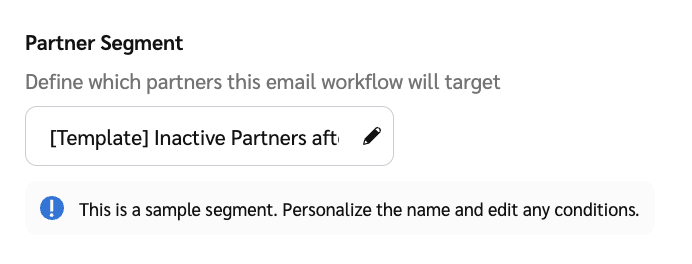
* In the *Partner Segment*, select  **\[Edit]** to view the default segment conditions.
* The segment's **pre-configured** conditions will work for most use cases. Optionally, you can [personalize them](/brand/what-would-you-like-to-learn-about/platform-features/reach-out-to-partners/email-workflows/partner-segments-for-email-workflows-explained.md) further to choose what triggers the re-engagement attempts—for example, if the partner has a low number of clicks, actions, revenue, or commission.
5. Set a **Send from** and a **Reply To** address for the email.
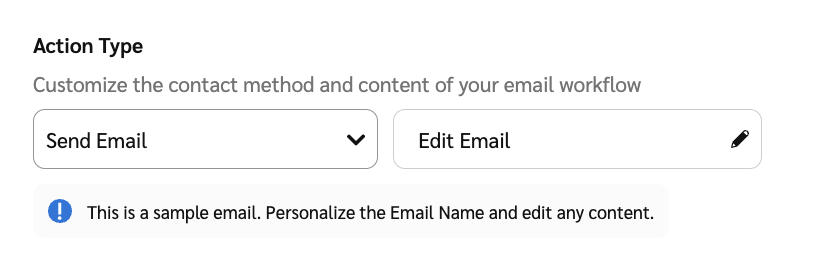
* Below the *Action Type*, in the *Edit Email* field, select  **\[Edit]** to specify the email addresses. Then, select **Done**.
6. Select **Save** to return to the email workflow setup screen. After you've customized all the email workflows, select **Activate Workflow** to launch them!
That’s it! We’ll reach out to your selected partners to re-engage them.
{% hint style="info" %}
**Interested in what else you can do with automated workflows?** Check out our documentation on [creating and managing email workflows](/brand/what-would-you-like-to-learn-about/platform-features/reach-out-to-partners/email-workflows/create-and-manage-email-workflows.md) and [automating decisions](/brand/what-would-you-like-to-learn-about/platform-features/review-partner-applications/automate-partner-application-processing/create-workflows-to-automatically-process-partner-applications.md) about partner applications!
{% endhint %}
---
# Agent Instructions
This documentation is published with GitBook. GitBook is the documentation platform designed so that both humans and AI agents can read, navigate, and reason over technical content effectively. Learn more at gitbook.com.
## Querying This Documentation
If you need additional information that is not directly available in this page, you can query the documentation by asking a question.
Perform an HTTP GET request on the following URL with the `ask` and `goal` query parameters:
```
GET https://help.impact.com/brand/what-would-you-like-to-learn-about/platform-features/reach-out-to-partners/email-workflows/reactivate-partners-with-email-workflows.md?ask=&goal=
```
`ask` is the immediate question: it should be specific, self-contained, and written in natural language.
`goal` is what the user is ultimately trying to achieve, the reason they need the answer. Sharing it helps GitBook give you a better, more relevant answer. A goal is most helpful when it describes the outcome the user wants rather than restating the question. For example, with `ask=how do I create an API token`, a goal like `automate deployments from our CI pipeline` lets GitBook tailor the answer to that use case.
The response will contain a direct answer to the question and relevant excerpts and sources from the documentation.
Use this mechanism when the answer is not explicitly present in the current page, you need clarification or additional context, or you want to retrieve related documentation sections.