> For the complete documentation index, see [llms.txt](https://help.impact.com/llms.txt). Markdown versions of documentation pages are available by appending `.md` to page URLs; this page is available as [Markdown](https://help.impact.com/brand/what-would-you-like-to-learn-about/platform-features/cross-channel-performance-insights/optimize-reports/optimize-metrics-explained.md).
# Optimize Metrics Explained
This article explains how impact.com gives credit for a conversion, like a sale or sign-up, to a specific partner in the different scenarios a customer might take, from a single click to a journey involving multiple partners.
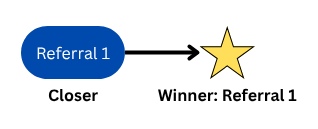
Single Step Path
In the simplest scenario, a customer clicks a link from a partner and converts. The *closer* thus wins attribution. Both the *participating click count* and the *participation count* are 1.
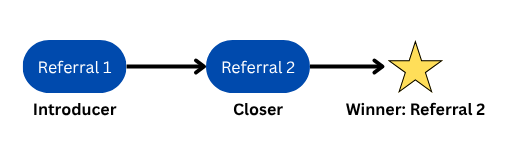
Two Step Path (One Partner)
In this path, a customer clicks twice on the links of the same partner, who acts as both the *introducer* (first click) and the *closer* (second click). The *closer* click wins attribution. The *participating click count* is 2, but the *participation count* remains 1, since only one unique partner was involved.
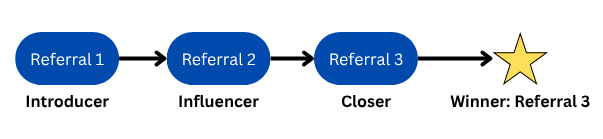
3 Step Path (One Partner)
In this path, the single partner now fills all the roles: *introducer* (click 1), *influencer* (click 2), and *closer* (click 3). The closer wins, the *participating click count* is 3, and the *participation count* is 1.
N Step Path (One Partner)
This generalizes the rule for any number (N) of clicks from the same partner. The partner is involved as the *introducer*, and on all intervening clicks, and as the *closer*. The *closer* (click N) wins attribution. The *participating click count* is N, but the *participation count* is always 1, since there is only 1 partner.
Two Partner Path
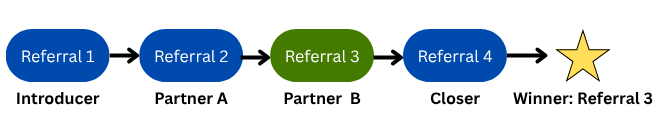
When 2 or more partners are involved, the *closer* is not always the *winner*. Either partner can be awarded credit, depending on how the attribution rules are defined. Partner B could win even if Partner A was the *closer*.
In the case that Partner A has 3 clicks and Partner B has 1, the *participating click count* is 4, but the *participation count* is only 2 (one for A, one for B).
Multiple Partners Path
As with the two-partner path, the *winner* can be a partner like Partner B based on contract terms, not necessarily the *closer* (Partner D). In a case where every click is from a unique partner, the *participating click count* (4) and the *participation count* (4) will be equal.
---
# Agent Instructions
This documentation is published with GitBook. GitBook is the documentation platform designed so that both humans and AI agents can read, navigate, and reason over technical content effectively. Learn more at gitbook.com.
## Querying This Documentation
If you need additional information that is not directly available in this page, you can query the documentation by asking a question.
Perform an HTTP GET request on the following URL with the `ask` and `goal` query parameters:
```
GET https://help.impact.com/brand/what-would-you-like-to-learn-about/platform-features/cross-channel-performance-insights/optimize-reports/optimize-metrics-explained.md?ask=&goal=
```
`ask` is the immediate question: it should be specific, self-contained, and written in natural language.
`goal` is what the user is ultimately trying to achieve, the reason they need the answer. Sharing it helps GitBook give you a better, more relevant answer. A goal is most helpful when it describes the outcome the user wants rather than restating the question. For example, with `ask=how do I create an API token`, a goal like `automate deployments from our CI pipeline` lets GitBook tailor the answer to that use case.
The response will contain a direct answer to the question and relevant excerpts and sources from the documentation.
Use this mechanism when the answer is not explicitly present in the current page, you need clarification or additional context, or you want to retrieve related documentation sections.